I don't want to be a curator of AI's ideas
Where your professional value actually lives when AI can produce instant output

Key Points:
Your professional value doesn’t live in all your work equally. It lives where you maintain creative agency, where you stay in the driver’s seat.
This feeling of lost ownership is the real discomfort we face when we over-rely on AI and slip from creator to curator without realizing it.
The craft isn’t “never use AI” or “always use AI.” The craft is knowing when your judgment matters more and when curating AI’s output is just fine.

Hello friends,
Last week I left you with a question: where does our professional value live when AI can produce instant polished output?
I’ve been trying to answer that question for a while now (here, and there). But finally I found a mental model that tells me WHEN my contribution actually matters, and when I can let AI handle execution without losing anything real.
If you’ve ever felt weird about how much AI helped, I figured out why.
I tasked an AI to search for the most relevant sources on what differentiates human and AI contributions to knowledge work.
But my prompt wasn’t specific enough, and AI went a few steps too far, doing the research synthesis by itself.
The synthesis was good and had some ideas I could build on.
And I felt... uncomfortable.
If I used it, it would be like reporting someone else’s thinking, not forming my own. I felt robbed and devalued. It’s been nagging me for days.
If you’ve ever felt weird about how much AI helped, you know this feeling.
That discomfort isn’t about using AI. It’s about something deeper.
It’s about the difference between creating and curating.
Between being in the driver seat versus being in the passenger seat.
Between doing creative work and arranging someone else’s output.
I felt uncomfortable being a curator of AI’s ideas.
Here’s what I’ve come to understand.
My value doesn’t live in ALL my work equally.
My value lives in the parts where I maintain creative agency.
Being in the driver seat. Deciding. Giving direction. Actually creating.
It’s not about HOW I do it (with or without AI assistance). It’s about WHO is driving.
The truth is: not all your work requires creative agency. Not all of mine does either.
Some work is fine as curation.
The craft is not about never use AI or always use AI.
The craft is knowing the difference, knowing when to use which.
Last week I introduced an analogy: the chef in a restaurant of the future, facing the food replicator (like in Star Trek) that produces perfect-looking dishes in seconds.
The chef makes food through a messy, longer process. The replicator creates almost flawless dishes instantly.
How does the chef justify his value?
I think he would say something like:
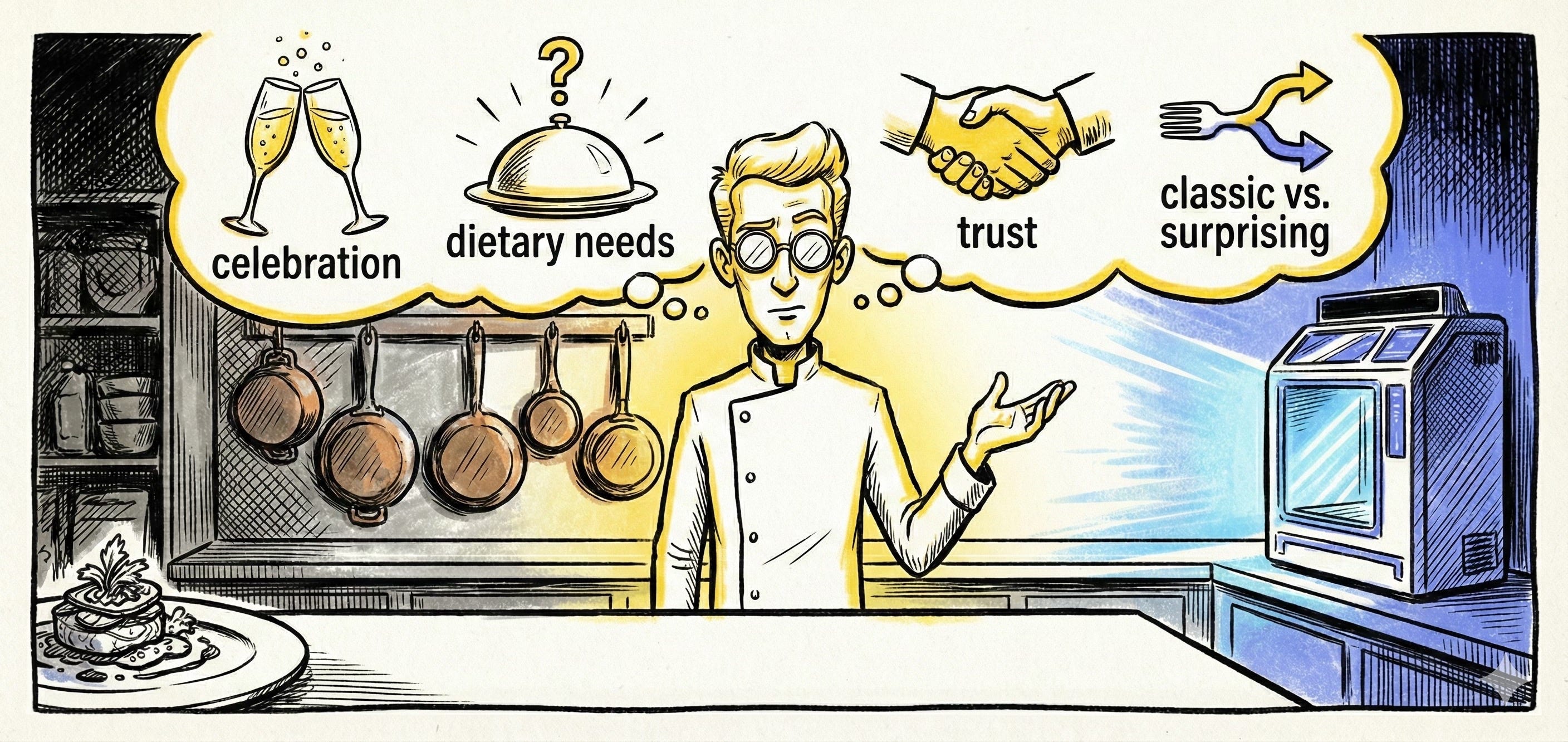
My value isn’t that I’m better than the replicator at every single task. My value is that I know WHEN my craft matters for THIS specific dining moment.
When you sit down tonight, I assess the context:
Are you celebrating something important?
Do you have dietary restrictions the database hasn’t seen?
Are you a regular who trusts my judgment, or skeptical?
Do you want perfect execution of a classic, or something surprising?
You’re not paying for molecules. You’re paying for my contextual judgment about when to deploy which faculties of my craft, and my accountability for getting that judgment right.
The replicator can match my PRODUCT when the context is standard. But it can’t match my PROCESS of reading your needs, assessing the situation, and deploying the right response.
When primary creative agency matters (special occasion, novel constraints, relationship-building, differentiation):
I’m in the driver seat from ingredient selection through plating
I draw on embodied experience of thousands of meals
I reason through novel combinations no database contains
I take full accountability for the experience
I create something uniquely suited to this moment
When secondary curation is fine (busy lunch service, standard preparation, proven techniques):
I let the replicator handle the reliable execution
I focus my creative agency on the touches that matter
I verify quality with my trained judgment
I still take accountability for the result
The chef’s value isn’t in avoiding the replicator. It’s in knowing when his judgment matters more than perfect execution.
This is true for your professional value too.
Remember that discomfort I felt when AI did the synthesis? That was the warning signal. Creative agency is the cognitive work that makes you irreplaceable.
The danger isn’t using AI. The danger is losing track of when you’re still driving versus when you’ve moved to the passenger seat.
Key principle: The goal isn’t to use AI for everything you can. The goal is to protect the thinking that makes you irreplaceable.
Knowing when creative agency matters is the first step. The next is knowing where it comes from.
Next week, I’ll share the three sources of irreplaceable professional value you must develop to stay in the driver’s seat.
Try This
Prompt: Where do you actually maintain your creative agency?
Your AI assistant already has a memory of how you work. You can ask it to show you the pattern you might be missing.
Important: Use this in the AI chat or project where you’ve done the most work. A fresh conversation has no data to analyze. If you haven’t used AI regularly for work tasks, this prompt won’t give meaningful results.
Copy this into ChatGPT, Claude, or Gemini (works best if you’ve used it regularly):
You know how I work and what I’ve been working on. Analyze our entire conversation history.

I want to understand where I maintain creative agency versus where I operate in curation mode.

Creative agency means: I’m in the driver seat. I’m deciding, giving direction, actually creating. The thinking is mine, even if I use tools to help execute.

Curation means: I’m arranging, editing, or executing based on someone else’s output (including yours). I’m in the passenger seat. The core thinking came from elsewhere.

Compare these two versions of me based on our conversations:
- What % of my work falls into each category?
- Which category builds my irreplaceable professional value?
- What am I protecting well? What am I at risk of losing?
- One pattern I should change this week

Be direct. Give me the uncomfortable truth, not reassurance.
If I’m losing ground, tell me. If I’m protecting the wrong things, tell me.
Treat the output as a starting point, not truth. The AI only sees what you’ve shown it. It may miss context, invent patterns, or tell you what sounds good. Challenge its conclusions.
I’d love to hear what you discover. Share your results in the comments or send me a DM. What patterns surprised you?
Mine said editing and research synthesis is where I should be more in the driver seat. Ouch.
A Final Thought
I’m writing about preserving creative agency while using AI to write about preserving creative agency.
The irony isn’t lost on me.
But here’s what matters. I stayed in the driver’s seat. The insights are mine. The struggle was mine.
The ownership is mine.
P.S. Next week I’ll share the three sources where your creative agency comes from, and how to develop them. This is the framework I’m building for the book, The Augmented Mind. If you want to stay in the driver seat of your own work, you’ll want to read it.
For professionals who earn by thinking and want to use AI without losing their thinking quality and intellectual ownership, join me as I figure this out.
Sources & Further Reading:
Dell’Acqua, F. et al. (2023). Navigating the Jagged Technological Frontier. Harvard Business School Working Paper 24-013. The BCG study with 758 consultants showing those using AI for tasks outside its capability frontier performed 19 percentage points worse than those working without AI.
Microsoft Research (2025). The Impact of Generative AI on Critical Thinking. Research on how AI confidence correlates with reduced critical thinking effort.
Harvard Gazette (2025). Is AI dulling our minds?. On cognitive offloading and maintaining independent thinking capability.